

.png&w=1920&q=75)
Overview
If you’re planning to build a home in Queensland, you may have heard terms like cyclone‑rated, wind region, wind class, or climate zone and wondered what they actually mean.
It’s a common and understandable question. Queensland includes everything from calm inland suburbs to cyclone‑prone coastal regions, so homes must be designed for the conditions where they will be built.
This guide explains, in plain English:
- What people usually mean by “cyclone rating”
- How wind ratings actually work in Queensland
- The difference between climate zones and wind classifications
- What applies to most parts of South East Queensland
- Why this matters especially for modular homes
First up: what does “cyclone rating” actually mean?
In Queensland, homes aren’t given a single, universal cyclone rating.
Instead, every permanent home — including modular homes — is engineered for a site‑specific wind classification under Australian Standards. These standards determine how much wind force the structure must be able to withstand, based on where and how exposed the home will be.
In everyday conversation, “cyclone‑rated” usually refers to homes designed for cyclonic wind regions, but the technical process is more precise than that.
Queensland wind regions (big picture)
Australia is divided into wind regions under Australian Standard AS 1170.2. In Queensland, the most relevant are:
- Region A & B – Non‑cyclonic regions (most of South East Queensland and many inland areas)
- Region C – Cyclonic regions (large parts of Northern Queensland)
- Region D – Severe cyclonic regions (far north Queensland)
Your wind region is determined by geography and forms the first step in structural engineering for a home.
Wind classifications (N and C ratings)
Within each wind region, homes are assigned a wind classification based on:
- How exposed the site is (open land, hills, ridge lines)
- Surrounding buildings and trees (shielding)
- Local topography
These classifications are expressed as:
Non-cyclonic wind classes
N1 – N3: Typical suburban and sheltered locations
N4 – N6: More exposed sites (elevated, coastal, open terrain)
In much of South East Queensland, N3 is commonly used as a baseline structural rating, with higher ratings applying where exposure requires it.
Cyclonic wind classes
C1 – C4: Cyclone‑prone regions, mainly in Northern Queensland
These require additional structural engineering to manage higher wind forces and uplift loads.
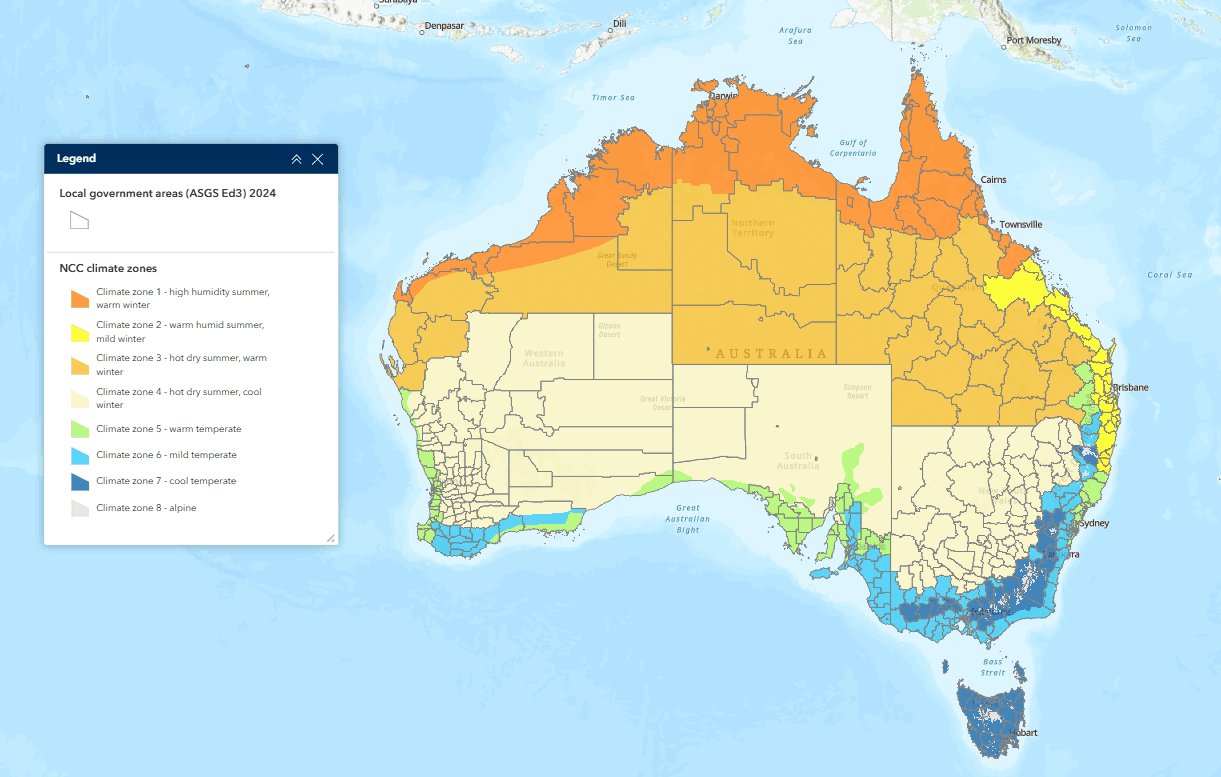
Reference: Australian Building Codes Board NCC Climate Zone Map
Climate zones vs wind classifications (important distinction)
These two concepts are often confused, but they serve very different purposes.
Climate zones
Climate zones are used under the National Construction Code to determine energy‑efficiency requirements, including:
- Insulation levels
- Moisture and condensation control
- Thermal performance suited to humidity and temperature
They affect how comfortable and efficient a home is to live in — not how strong it is structurally.
Wind classifications
Wind classifications relate to structural integrity, including:
- Framing strength
- Bracing and tie‑down systems
- Connections between roof, walls, and foundations
Wind classification determines how the home is engineered to resist wind loads.
In simple terms:
Climate zones = comfort and energy efficiency
Wind classifications = strength and safety
Both are assessed separately and both are required for council approval.
Why this matters for modular homes
With modular construction, the correct wind classification needs to be identified early.
That’s because modular homes are engineered and built in a controlled factory environment before being delivered to site. The structural design — including bracing, tie‑downs and framing specifications — must match the wind classification from the outset.
Getting this right early helps ensure:
- Smooth approvals and certification
- Accurate pricing
- No redesigns after manufacture
- Faster installation on site
Are modular homes strong enough?
Yes, when engineered correctly for their site.
Modern modular homes are designed to meet the same Australian Standards as traditional homes, and in many cases exceed baseline requirements due to:
- Precision‑built steel framing with high tensile strength
- Full structural bracing systems
- Controlled construction conditions
- Structural loads experienced during transport that exceed many static conditions
The key isn’t whether a home is modular or traditional — it’s whether it’s engineered for the correct wind classification at the start.
How do you know what applies to your block?
Your wind classification is confirmed during early planning and engineering, based on:
- Property location
- Exposure and terrain
- Surrounding structures
- Council and code requirements
It’s not something homeowners need to determine themselves — but understanding the basics helps avoid confusion later.
The takeaway
- “Cyclone rating” is a common term, but in practice homes are engineered for site‑specific wind classifications
- Most South East Queensland homes fall within non‑cyclonic wind classes (often N3)
- Cyclonic ratings apply primarily in Northern Queensland
- Climate zones and wind classifications are different.
If you’re planning a build in Queensland and want clarity on what applies to your site, it’s worth discussing it early before design and pricing are finalised.
Oly Homes can provide a free concept site plan to help assess your block and show how a home could work on the land.
Kingaroy Veterans and Community Centre taking shape
See how Oly Homes is delivering the new Kingaroy RSL Veterans and Community Centre, with factory construction progressing alongside works on site.

Oly Homes
1 Oct 2026

How to Save Money When Building a New Home
Discover how choosing an existing home design can save time and money while still creating a home that suits your lifestyle. Read more →
Oly Homes
26 Jun 2026
Featured in Salt Magazine: A New Perspective on Modular Homes
Oly Homes is featured in Salt Magazine Winter 2026, highlighting how modern modular homes on the Sunshine Coast are changing the way Australians build.
Oly Homes
23 Jun 2026